


On February 5, People's Daily published an article titled “High-Speed Rail Technology Powers Breakthroughs in Wind Energy Equipment”, highlighting how CRRC Corporation Limited is cultivating a “second growth curve” by building on shared technologies and integrated industrial chains. The report outlines CRRC’s path of capability transfer and system-level coordination as a model for the transformation and upgrading of central state-owned enterprises.
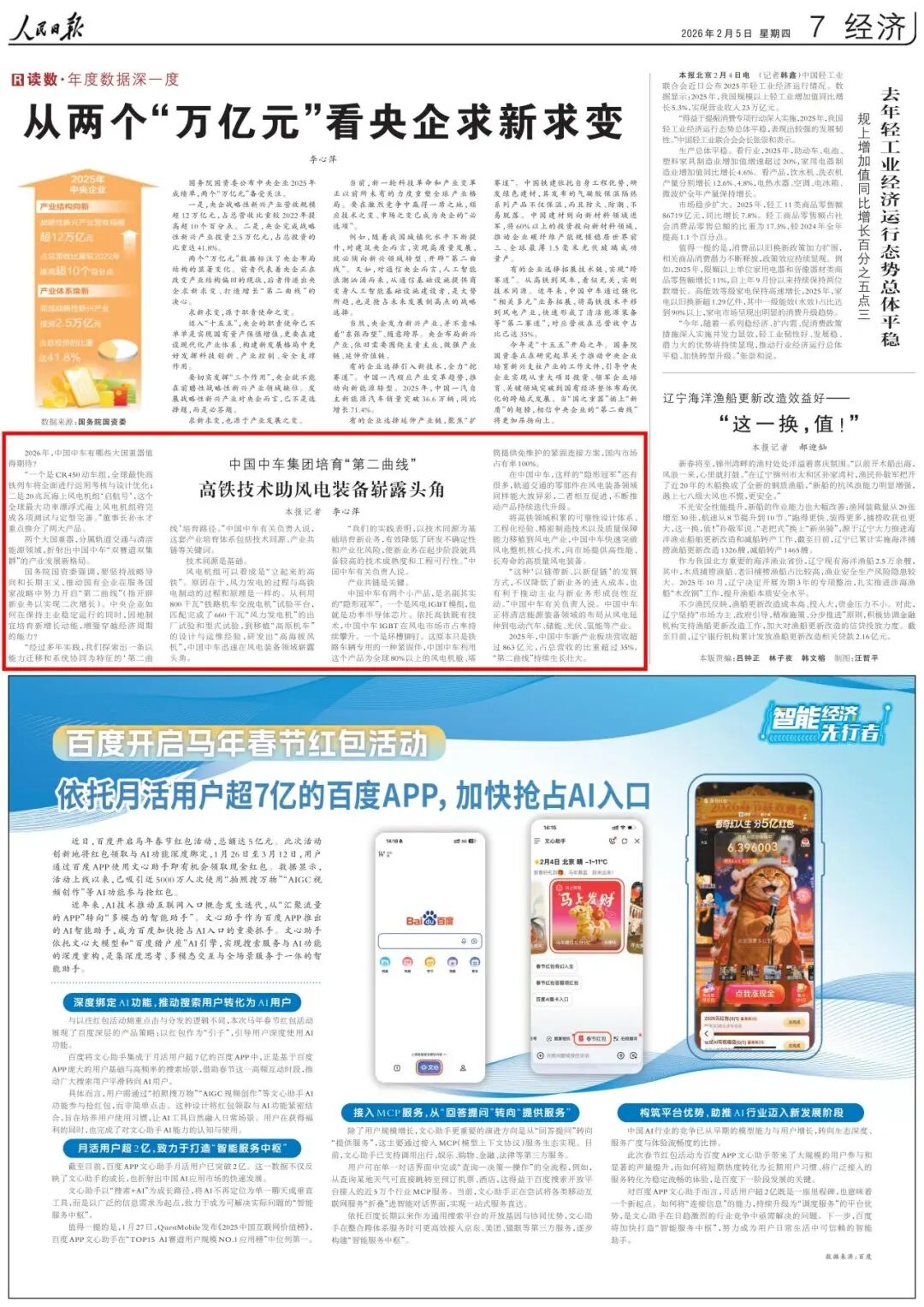
CRRC Group Cultivates a “Second Growth Curve”:
High-Speed Rail Technology Drives Wind Power Equipment to Prominence
Looking ahead to 2026, CRRC Chairman Sun Yongcai spotlighted two major products: the CR450 EMU, expected to undergo comprehensive operational testing and design optimization as the world’s fastest high-speed train, and the “Qihang” 20 MW floating offshore wind turbine, the world’s highest-capacity floating offshore wind unit, set to complete testing and final validation.
These two flagship products—spanning rail transit and clean energy—reflect CRRC’s emerging “dual-track, dual-cluster” industrial development model.
China’s State-owned Assets Supervision and Administration Commission (SASAC) has emphasized a long-term, strategy-driven approach for state-owned enterprises to cultivate a “second growth curve”—developing new business lines to achieve renewed growth. CRRC’s experience offers a practical example of how to stabilize core operations while fostering new growth engines tailored to evolving national strategies.
Shared Technology as the Foundation
CRRC describes wind turbines as “high-speed trains standing upright.” The analogy lies in the principle: the process of wind power generation mirrors the electrical braking system of high-speed trains. From adapting an 800 kW railway locomotive AC motor test platform to complete factory and type testing for a 660 kW wind generator, to transferring high-altitude locomotive design and maintenance expertise to develop high-altitude wind turbines, CRRC quickly established a foothold in the wind power equipment sector.
According to CRRC representatives, building new businesses on shared technological foundations reduces R&D uncertainty and industrialization risks, enabling new ventures to begin with high technical maturity and strong engineering feasibility.
Integrated Industrial Chains as the Key
CRRC’s industrial chain integration strategy has also produced multiple “hidden champions.” Drawing on high-speed rail technology, CRRC’s wind power IGBT modules—power semiconductor chips—have steadily increased their market share in the wind energy sector. Meanwhile, its grooved rivets, originally developed as specialized fasteners for railway vehicles, now provide maintenance-free fastening solutions for more than 80% of global wind turbine nacelles and towers, achieving 100% domestic market share in China.
Many rail transit components have found new applications in wind energy, creating mutual reinforcement between the two sectors and accelerating product iteration and upgrades.
By transferring reliability engineering systems, precision manufacturing capabilities, and quality assurance frameworks from high-speed rail to wind power, CRRC has rapidly overcome key technological barriers in wind turbine manufacturing, delivering high-performance, long-life equipment to the market.
This “chain-driven innovation” model—using established industrial chains to nurture new businesses while allowing new businesses to strengthen existing chains—reduces entry costs and promotes positive interaction between core and emerging segments.
A Growing Second Curve
CRRC is expanding its clean energy footprint beyond wind power into electric vehicles, energy storage, photovoltaics, and hydrogen energy.
In 2025, revenue from CRRC’s emerging industries exceeded RMB 86.3 billion, accounting for more than 35% of total revenue. The company’s “second growth curve” continues to gain momentum, demonstrating a scalable path for state-owned enterprises seeking transformation and long-term resilience.
